There are plenty of things Second Life prepares you for. You will eventually spend far too much money on a house you don’t actually need, discover that your beautifully decorated living room needs 147 LI more, spend twenty minutes trying to get the perfect photograph only to discover that your avatar has been standing with one foot inside the coffee table, and become emotionally attached to people whose actual faces you may never have seen.
You will make friends with people who live thousands of kilometers away, fall in love with someone you met as a collection of pixels, build businesses and communities together, have arguments over things that seemed extremely important at the time and then laugh about them years later.
What Second Life doesn’t really prepare you for is someone dying.
Not someone disappearing for six months, not someone announcing they are taking a break from Second Life and then returning three years later with a completely different mesh head, and not even someone who simply vanishes without explanation. I mean actually dying, in real life. Because if you’ve been around Second Life long enough, eventually it happens, and when it does, this virtual world can suddenly become a surprisingly real place to grieve.
💔 The Person Behind the Avatar
I’ve heard and read about Second Life friendships as though they are somehow less real because they happen through a computer screen, and I’ve never really understood that argument. If someone makes you laugh, listens to your problems, supports you when you’re having a terrible day, inspires you, annoys you, works beside you, loves you, argues with you, or simply becomes part of the rhythm of your everyday life, does it really matter whether you were sitting across a restaurant table from them or sitting behind a computer screen together?
The relationship is still happening, the conversations happened, the memories happened, and the feelings certainly happened. When that person dies, the fact that your friendship existed through avatars and pixels doesn’t magically switch off the emotional connection you had with the person behind the screen.
What can make it complicated is that sometimes the people around you in real life don’t even know this person existed. You might be sitting at your kitchen table, staring at your computer screen and crying because someone you cared about has died, while your partner, family, colleagues or friends have absolutely no idea who you’re crying about.
Saying “my Second Life friend died” can feel strangely inadequate, because suddenly you are expected to explain what Second Life is, how you met, what your relationship was, why this person mattered to you and why their absence hurts so much, all while you’re already trying to deal with the fact that someone who was part of your life is no longer there. Sometimes you don’t have the energy for that explanation, and sometimes you aren’t even sure how to explain it yourself.
There is something very lonely about grieving a person whose existence isn’t known to the people around you, because you can feel as though you are carrying something that nobody else can see. Your grief is completely real to you, but the outside world may not recognise the relationship that created it. It can almost feel as though you need to defend your right to be sad, which is rather absurd when you think about it.
Grief doesn’t check the geographical coordinates of a friendship before deciding whether it is allowed to enter your life, and there certainly isn’t some invisible grief police standing behind you saying, “Excuse me, you only met them on the internet, please take your sadness elsewhere.”

🥀 Can You Grieve Someone You Met in Second Life?
Of course you can, and I think it is important to say that without adding a giant disclaimer afterwards. You don’t have to justify it, explain it or convince anyone that the relationship was sufficiently important to qualify as “real grief”.
If somebody mattered to you, then losing them hurts, regardless of where you met them or how much of their real life you knew. Second Life can create friendships that last for years, relationships that become deeply intimate, working partnerships that involve enormous amounts of time and trust, and communities where people become part of one another’s daily routines. When one of those people dies, there is suddenly an empty space where that person used to be, and the fact that the space exists inside a virtual world doesn’t make it any less empty.
In some ways, losing somebody from Second Life can even be more confusing because the world itself continues as though nothing happened. Their house may still be there, their shop may still be open, their creations may still be sitting exactly where they left them, and their name can continue appearing in places where you expect to see it. Their profile doesn’t suddenly become a memorial plaque. Their name on your friends list doesn’t disappear with a little solemn chime.
Second Life simply carries on, because the platform doesn’t know that the person who was sitting behind that avatar yesterday will never log in again.
👥 The Friends List Question
What do you do with somebody who has died when their name is still sitting there among all the people who are online, offline, busy or simply ignoring you? Do you remove them because seeing their name every time you log in is painful, or do you leave them there because removing them feels strangely like deleting a person? Do you keep their profile, their calling card, their photographs and your old conversations, or do you eventually clean everything out because you need to move forward?
There is no correct answer, and I suspect everyone will find their own way of dealing with it.
I still have someone on my friends list who died eleven years ago. He was a very close friend, and for a long time his name being there carried a little punch of sadness every time I saw it.
But grief changes, and over the years that sharp sadness slowly made room for something much softer. I still have his picture in one of my homes, too, and it doesn’t feel like a shrine or a monument to someone I have lost; it feels more like keeping a photograph of an old friend in your house.
I see it and remember him, and instead of the overwhelming sadness there is mostly affection, nostalgia and the occasional thought of how much he would probably have laughed at something that happened five minutes ago.
I think that is one of the things about grief: eventually it can change shape. The person doesn’t become less important, but the pain of their absence can slowly make room for the warmth of having known them. You don’t necessarily stop missing someone; you simply stop being surprised by the fact that they are gone.
🕯️ Finding Somewhere to Put the Grief
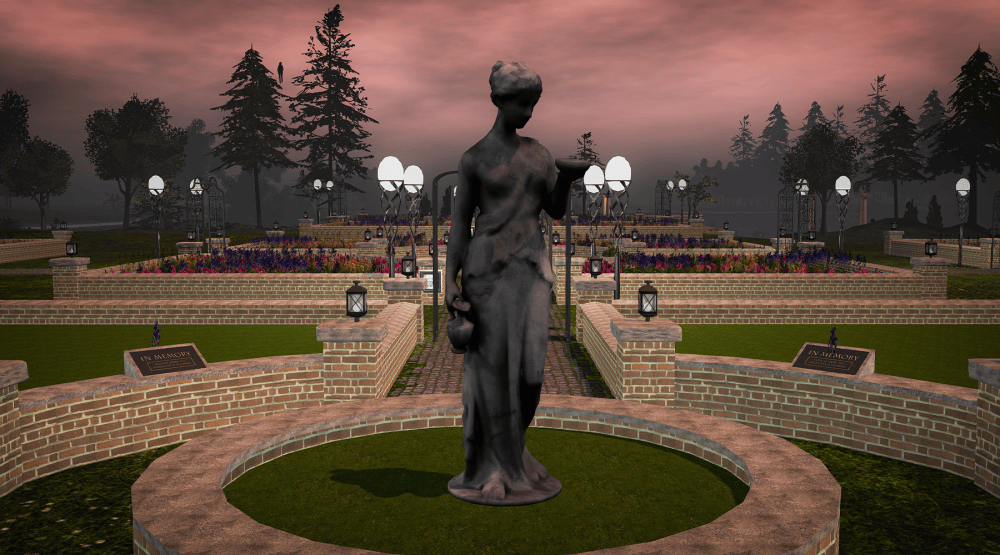
One of the things I find rather wonderful about Second Life is that there are places where people can go when they don’t quite know what else to do with those feelings. There are memorial gardens, churches, cemeteries, spiritual regions and quiet corners of the grid where people can sit, think, pray, remember or simply be alone for a while.
I was fortunate in my own experience because, after the Second Life memorial gathering, I eventually had the opportunity to meet up in real life with a mutual Second Life friend, and we had some drinks, talked about our friend, shared memories and, in our own way, sent him off together. That meant a great deal to me, because for a little while I didn’t have to explain why I was sad. Someone else already knew.
Not everyone has that.
For some people, a Second Life memorial may be the only place where they feel they can openly acknowledge the loss, and I think that is perfectly legitimate. It might be a beautiful garden created in someone’s memory, a photograph placed somewhere meaningful, a gathering of friends at a favourite location, or simply sitting quietly in a place that reminds you of them. It doesn’t have to be grand or spiritual or even perfectly organised. Sometimes the most meaningful memorial is simply being somewhere together and talking about the person who isn’t there anymore.
🪦 When We Discover More About the Person Behind the Avatar
There is another complicated side to death in Second Life, and that is what happens when we suddenly discover things about their real life that we didn’t know while they were alive.
Sometimes we learn that somebody was considerably older or younger than people assumed, lived somewhere completely different, had a completely different profession, or had created a version of their real life that didn’t match the reality.
When that happens, people can have very different reactions, and I don’t think any of those feelings should automatically be dismissed. Some people may feel betrayed or lied to, while others may simply be curious, surprised or completely unsurprised. Some may wonder what else wasn’t true, while others may shrug and think, “Well, that was their business.”
Personally, I fall very firmly into the last camp. I don’t particularly care how somebody chooses to portray their real life in Second Life.
If you are my friend in Second Life, I don’t feel entitled to a complete biography of the person sitting behind the avatar. You can be younger or older than you say you are, live in a different country, or present yourself as a successful entrepreneur when your real-life occupation is a part-time cleaning job. You can tell me you live in a castle when you actually live in a perfectly ordinary apartment with a neighbour who owns an enthusiastic vacuum cleaner. Unless your real-life identity is directly relevant to something we are doing together, I don’t necessarily need to know.
After all, Second Life is one of the few places where we are explicitly encouraged to be whoever we want to be. We dress differently, look different, live differently and sometimes behave very differently from the people we are in real life. So I find it difficult to celebrate that freedom while simultaneously becoming offended when somebody actually uses it.
Obviously, deliberate deception that involves manipulating, exploiting or harming another person is an entirely different matter, but simply choosing not to disclose the details of your real life isn’t something I believe we should automatically interpret as betrayal.
And perhaps death shouldn’t suddenly give us an entitlement to information that someone never wanted to share while they were alive.
🏠 What Happens to Their Second Life?
Then there is the slightly surreal question of what happens to everything they leave behind. Their land, their home, their business, their creations, their groups, their inventory and, of course, their avatar can all continue existing after the person behind them is gone, at least for a while.
Their house doesn’t suddenly disappear because its owner died, and their furniture doesn’t know that the person who used to sit on it every evening isn’t coming back. Somewhere in the enormous machinery of Second Life, their account may simply continue to exist, quietly frozen in time.
But that doesn’t necessarily mean that everything they left behind will remain there forever. Unless arrangements have been made beforehand, for example through a will or whatever other arrangements Linden Lab allows, land and other account-related holdings still depend on the account being maintained and paid for.
Once those payments stop, the land can eventually be reclaimed and objects or other things tied to the account can disappear with it. So that beautiful home, that carefully built business or that little corner of the grid that somebody spent years creating may one day simply be gone, not because someone deliberately erased it, but because the account quietly stopped being maintained.
There is something both beautiful and slightly eerie about that. We spend so much time building things in Second Life, decorating homes, creating businesses, making art, scripting objects and leaving little traces of ourselves all over the grid, and eventually we have to accept that our digital existence may outlive our physical one, but perhaps not forever. Someone else may eventually visit a place we built without knowing who we were, or they may remember us because they once sat in our living room, bought something from our store or danced with us at a club. And then, one day, the place may be gone, leaving only the memories of the people who knew it was ever there.
It also raises practical questions that most of us don’t think about until it is too late. What happens to your account when you die? What happens to your Linden dollars, your land, your creations and your business? Is there anything you would want somebody else to know or take care of? And what, exactly, do you want to happen to all those embarrassing pictures in your inventory?
Fortunately, Linden Lab has information about what happens to Second Life accounts and related matters after a resident dies, and it is worth reading rather than assuming that your avatar will simply ascend peacefully into the pixelated afterlife.
Linden Lab: Death and other worries outside Second Life
It may seem like a morbid thing to think about while you’re perfectly healthy and happily shopping for another sofa you absolutely do not need, but perhaps it is no different from making practical arrangements for any other part of your life. Second Life can feel eternal while you’re logged in, but the person behind the avatar isn’t.
❤️ There Isn’t a Wrong Way to Remember
So if you’ve lost someone from Second Life, I don’t think there is a rulebook telling you what you should do next. You can keep them on your friends list if that feels right, or remove them if seeing their name is too painful. You can even stay partnered, or not. You can keep their photographs and stuff they gave you, or you can eventually let those things go. You can visit a memorial garden, attend a service, find a spiritual place, talk to other mourners or simply sit somewhere alone and remember. You can tell people in your real life what happened, even if they don’t completely understand, or you can keep that part of your life private.
You can cry, you can laugh, and you can do both in the same conversation, because humans are wonderfully inconsistent creatures and grief has never been particularly interested in following a tidy schedule.
And if nobody in your real life knows who you’re grieving, that doesn’t make the grief less legitimate. You don’t need to prove that a relationship was real by producing a photograph of the two of you standing together in a restaurant. Sometimes a friendship exists in words, sometimes it exists in pixels, and sometimes it exists in years of shared experiences that nobody else could possibly understand.
Eventually, the person you lost may become less of an open wound and more of a memory you carry around with you. You might still think of them when you log in, you might still visit somewhere you went together, and you might still occasionally wonder what they would have thought about whatever ridiculous thing is happening on the grid today. The sadness may still be there, but it has made room for affection, nostalgia and gratitude.
Maybe that is the strangest and most beautiful thing about Second Life and death. We build these enormous digital places knowing perfectly well that eventually we will all log off, but while we are here, we leave pieces of ourselves behind. We leave buildings and businesses and photographs and creations, but perhaps the most important things we leave behind aren’t objects at all. They are the people who remember us, the stories they tell about us, the jokes they still laugh at, the places that still remind them of us, and the little pieces of our lives that continue to exist in their Second Life.
Not alive. Not exactly gone, either.
Links:
Linden Lab Official: Death and Other Worries outside Second Life
Linden Memorial Park – Flower dedications
Linden Memorial Park Candle Beach – Candle dedications


I attended an in-world memorial service for a fellow WHIP Radio broadcaster who had passed away after a long period of illness. That was somewhat surreal as I was the only non-Gorean and non-human present, but I wanted to show my respect as she had been doing the slot before mine when I first joined the station.
There are a lot of memorials now for departed Goreans who passed away. Not sure how if that now outnumbers the number of folks still actively in Second Life Gor. 🙁
I have a memorial keepsake for another fellow WHIP manager who passed away suddenly a few years ago. One of the few things I’m holding onto as I downsize my Second Life.
I didn’t know Black Ort, arguably one of the leading figures in Second Life Gor, who passed away last year, but I know his widow (and in-world partner). The grief is very real. 🙁
I’ve not told my family about my Second Life yet. I’m considering just letting my account lay dormant until such time as Linden Lab decides to delete it (or Second Life itself shuts down), as there will be enough balls for my next-of-kin to juggle after I’m gone. I’ve put down contact emails for some folks in Second Life, so hopefully they can then let others know.
(I know what prompted the blog post. Thankfully I didn’t look at the Forum thread about it, but from what I’ve heard some folks just can’t let go of a grudge. 🙁)
LikeLiked by 1 person
Thanks for sharing, Spiffy. Hope you don’t have to attend too many memorials in future, sounds like you had you share, hugs.
LikeLike
It’s ironic to read this now as we prepare for an in-world memorial service for a dear friend later today. This definitely describes a peculiarly unique situation when the loss of a virtual loved one is also very real to the persons whose lives have been touched by them in world. RJ Mesmeriser was such a friend and as we say goodbye to him I will definitely keep what you have said in mind and recommend it to others who are grieving today. Thank you, Caitlyn.
LikeLiked by 1 person
So sorry for your loss, Arabella. Wishing you and your friends strength and love, hugs.
LikeLike
Great piece Caity! Mortality will continue to be an increasing problem as the age profile of SL inhabitants skews towards the aged and deskbound, and the lack of resolution in relationships is likely to trouble those who are left behind. Personally, I ams prompted to make a Public Service Announcement that “I’m Not Dead – YET!” (and actually I think I might have a redundant blog somewhere with that title!) after completely defeating two types of cancer a couple of years ago – and I am now fitter and enjoying life more (except when I miss four foot putts) than when I quit SL because some nasty types were wishing cancer on me…
Pep (You and your more thoughtful readers might enjoy Goffman’s “Presentation of Self in Everyday Life” and relate it to the sort of identity issues raised by SL)
LikeLiked by 1 person
Thank you, Pep! What a lovely surprise to find you here after all these years! 😊 And congratulations on beating both types of cancer.
Your “I’m Not Dead YET!” announcement made me smile, and it’s a good reminder that disappearing from SL doesn’t necessarily mean disappearing from the world! Thank you also for the book recommendation, will look it up!
LikeLike
@caitlintobias.com it is not "new" for 2nd life. It happened to me on good old phpBB boards as well – folks I know only online suddenly (or not so suddenly) died.
Beside that, everything about the grieve, about lack of compassion and lack of understanding in your "real world" social context is true.
LikeLiked by 1 person
Remote Reply
Original Comment URL
Your Profile
Why do I need to enter my profile?
This site is part of the ⁂ open social web, a network of interconnected social platforms (like Mastodon, Pixelfed, Friendica, and others). Unlike centralized social media, your account lives on a platform of your choice, and you can interact with people across different platforms.
By entering your profile, we can send you to your account where you can complete this action.
Thank you for sharing this, Reinald. You’re absolutely right, online friendships and the loss of people we’ve only known through the internet are certainly not new. I think what has changed is how much of our lives and relationships now take place online, including in virtual worlds like Second Life. And yes, the grief can be very real, even when the people around us don’t quite understand it.
LikeLiked by 1 person
I dare say this is an issue in OpenSim at least as much in Second Life, if not more so. OpenSim is where those go who can’t afford Second Life (anymore), and thus, OpenSim has become a kind of a platform for the old, the sickly, the physically broken, more than Second Life even.
It’s already kind of jarring to find out that someone whose creations are still very popular is no more. Selea Core who gave us tons of sim decoration (2016). Áine Caoimhe who gave us PMAC and the Clubmaster (2019). Arcadia Asylum (2016); she actually wasn’t in OpenSim, but she gave permission for all her creations to be imported into OpenSim where people are trying to preserve them now.
Not long ago, Luna Lunaria ascended to the Big Sky Platform very suddenly. Although she was a commercial creator in OpenSim, the “Never buy in OpenSim” crowd did not try to bully her out of OpenSim because her creations were more spectacular than anything that came in from SL (or what the importers had made out of it). Nobody had tried to copybot her shop sim to “liberate” her works and offer them as full-perm freebies either. All her sims in the Wolf Territories still exist, and her items can still be bought, only that there’s nobody to upgrade her Blinn-Phong creations to PBR.
I’ve heard of a few sudden deaths over the last few years. Two of them were acquaintances of mine, and their spouses still are. One of the two owners of Soul-Grid, Rudi Bakerly, left us this way. He was lying on the sofa. His wife Nasti, fortunately the actual tech admin, went into another room, came back, and he was lifeless. Just like so. It was quite shocking to the community.
My main home grid is Dorenas World, the oldest German grid and the third-oldest OpenSim grid that still exists, officially launched in January, 2010. Dorena Verne is the tech admin and event organiser, but most of the extensive, highly detailed, but very performant mainland was built by her partner, Anachron Young, grid resident number two from the very beginning.
The grid has lost its share of residents to other causes than just moving on, but when they had their own sims, Dorena kept it running. One sim to the east was built by a resident who passed before I joined. One resident who used to be a party regular, and who only owned a parcel, was last seen on New Year’s Eve a few years ago and then suddenly disappeared. Her parcel is left untouched. (She kept her real life almost entirely secret, so nobody knows what happened to her, although we know that her Internet connection was so bad that she considered abandoning it. But even then she would have said farewell.) Another resident who had set up his own sim a few years ago, and who had lots of avatars with lots of names on lots of grids, died of an unnatural cause after that. We held a memorial for him with a solemn DJ set on his still existing sim.
Anachron himself was struggling with COPD, and as there’s no cure for it, it was clear that he would succumb to it one day. Still, he was an active builder and an active DJ with a themed set every Friday evening, one of the longest-standing DJ events around the Hypergrid. Up until fairly recently, there had been only three Fridays without his event.
A bit over a year ago, Anachron was diagnosed with cancer. It was then that he had to cancel several events in a row for the first time. During his chemo, he did return with two-hour sets whenever he could. Unfortunately, the chemo barely managed to slow the cancer down; it was terminal. Needless to say that this took a huge toll on Dorena. The two were moving into a hospital, back home and eventually to a hospice. Two weeks ago, Anachron returned with another Friday set of an hour an a half; it was that short because it was so spontaneous that he didn’t get to put together a longer set. Still, I think it was his first set at which he didn’t speak.
I’m glad I managed to be there against all odds on that day. For things went downhill from then on so quickly that Dorena didn’t appear to any of the events she regularly attends this week. Two days ago, Anachron passed away. In a twist of fate, it was his COPD that got him. Despite all the signs, it was quite a shock to a whole lot of people who had only ever met him in-world. It remains to be seen how Dorena will cope with this; however, she said a while ago that she’ll keep her grid online to preserve Anachron’s work.
Speaking of COPD, the worst thing that can happen is something that cannot happen in Second Life. And that’s when the only owner of a grid dies, and there’s nobody to take over the grid.
This happened to Caledonia Grid, Cayoun Daydreamer’s lifework. It had several Scotland-themed sims on which Cay had built all buildings himself, and there also was a very popular event sim on which Cay used to play up to three events per week. His longest-standing event was his Thursday blues evening; on some days, he would change the theme and play music by one or several certain artists. Cay knew a lot about music, he had a huge archive, and when he announced he’d play the blues, he actually would.
However, he was suffering from COPD, too. Eventually, this would cause him to cancel all his events, come back with only the blues evening, sometimes with more events, and then cancel them again.
While he was the official owner and the builder of Caledonia, he was not the tech admin. But he paid for the grid.
Given his popularity in the German community, his rather sudden passing was followed by a memorial event with more avatars than were allowed on his event sim so that avatars clad in black had to try again and again until someone had left. A small memorial installation was left outside the main event hall where the blues evenings used to be held. The intention was to keep Caledonia running and preserve Cay’s work as well as the memorial installation, just with no more events.
Unfortunately, nobody was found who could have adopted Caledonia and paid for it, so the grid found its end not even a month later. Cay was the last active local resident, and what few other active residents it used to have had moved on to other grids long enough ago. Still, his creations ceased to exist.
On the other hand, while Cay wasn’t the tech admin, he was the only one with admin permissions in-world, so he was the only one who could go and fix things that broke. I guess that if Caledonia had been left online, it would have turned into a “zombie grid” with more and more scripts no longer working and eventually even entire assets breaking and nobody able to fix them.
LikeLiked by 1 person
Remote Reply
Original Comment URL
Your Profile
Why do I need to enter my profile?
This site is part of the ⁂ open social web, a network of interconnected social platforms (like Mastodon, Pixelfed, Friendica, and others). Unlike centralized social media, your account lives on a platform of your choice, and you can interact with people across different platforms.
By entering your profile, we can send you to your account where you can complete this action.
Thank you for sharing all these stories. They really bring home how much this is not unique to Second Life, but something that affects every online community where people build friendships, create things, and become part of each other’s lives. It’s especially heartbreaking to realise that sometimes we lose not only a person, but also the worlds they created and everything they contributed to their communities. We often take it for granted that these virtual places and friendships will always be there, until suddenly they aren’t. Thank you for adding this perspective to the conversation.
LikeLike