There are many things we like to pretend we don’t do in Second Life. We don’t stalk people, we are merely admiring the scenery. We don’t shop compulsively, we are supporting the economy. We don’t spend six hours changing our outfit, we are working on our personal aesthetic. And we certainly, absolutely, categorically do not gossip. We merely exchange information, very important information, usually concerning other people, and for some mysterious reason this information simply cannot possibly wait until tomorrow.
Because gossip is one of those ancient human traditions that has survived pretty much everything, including the invention of the internet, social media, smartphones and the terrifying ability to accidentally send a screenshot to the person who is actually in the screenshot. If there is one thing Second Life has demonstrated over the years, it is that giving humans avatars, instant messaging and an enormous number of tiny interconnected social circles has not eliminated gossip. If anything, it has given gossip better lighting, nicer clothes and the ability to arrive directly into your inbox.

💬 The Pros: It Is Basically Social Research
Let us begin with the positive side, because surely there must be one, and if we are going to defend the ancient art of gossip we should at least make a convincing case before somebody reports us to the Second Life Department of Appropriate Social Behaviour.
The truth is that gossip can be fun. There, I said it.
Sometimes you are sitting at a club, wandering around an event or standing in a shop pretending to carefully examine a fatpack of shoes when someone sends you an IM beginning with those magical words, “Okay, don’t tell anyone, but…” and suddenly your completely ordinary evening has become an episode of Second Life: The Real Housewives of Somewhere Expensive. You may learn that somebody has broken up with somebody else, that somebody has apparently bought an enormous parcel purely to prove a point, that somebody is no longer speaking to somebody they were previously inseparable from, or that somebody has been seen wearing the exact same outfit three times this week, which is obviously information of such enormous importance that the United Nations should probably be collecting it.
There is, admittedly, a social function to all of this. Humans have always used stories about other humans as a way of bonding, comparing experiences and figuring out the complicated social landscape around them, and Second Life is no different. When you have been around for a while, you inevitably develop a mental map of who knows whom, who runs what, who used to be together, who had a spectacular falling-out in 2017 and who still refuses to stand within twelve meters of whom at a party. You don’t necessarily want to know all of this, and you certainly didn’t ask for the complete historical background of somebody’s divorce, store closure or feud over a breedable Meeroo, but somehow you now know, and once you know, you cannot unknow it.
In that sense, gossip can actually make Second Life feel more alive. Beneath all those beautiful avatars, polished profile pictures, destinations, shops, events and carefully curated social media feeds is a wonderfully messy little human society, complete with friendships, rivalries, romances, misunderstandings, alliances, grudges and people who mysteriously disappear from your friends list without explanation.
A completely gossip-free Second Life would probably be wonderfully peaceful, but it might also be strangely sterile. Imagine going to a club where everybody politely discusses the weather, nobody has ever fallen out with anybody, nobody has ever dated anybody’s ex and absolutely nobody has a suspiciously strong opinion about the latest drama happening in their little corner of Bellisseria. You would probably leave after twelve minutes and go back to shopping.
And then there is what I would call the therapeutic form of gossip, which is not really about destroying somebody’s reputation at all, but about finding another human being who understands why something ridiculous has just happened to you. Sometimes you simply need to tell somebody, “You will never believe what happened,” and have them respond with, “Oh, I absolutely believe it, because this is Second Life.” That shared understanding can be surprisingly comforting, particularly because some situations are so uniquely Second Life that attempting to explain them to somebody in Real Life would probably result in a concerned phone call to your doctor.
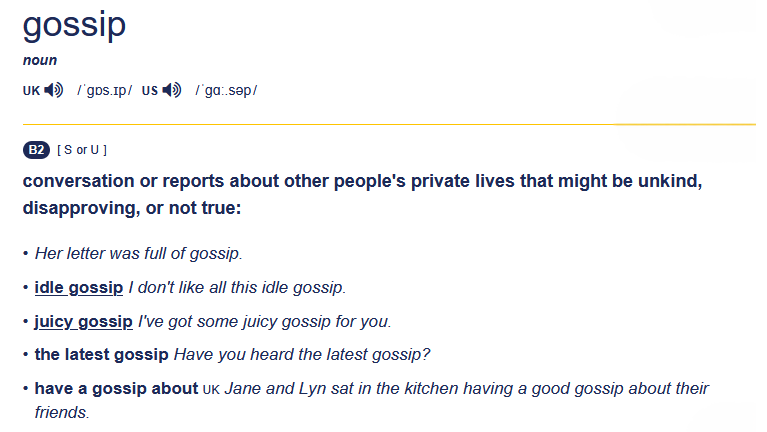
💣 The Cons: Gossip Has a Very Long Memory
Unfortunately, gossip has one rather significant disadvantage, which is that other people exist. They have ears, friends, screenshots, group chats and occasionally an absolutely amazing ability to remember something you said in 2014 while simultaneously forgetting why they walked into the room five minutes ago.
The problem with gossip is that it rarely stays exactly where you put it. You tell one person something because you trust them, that person tells another person because they trust them, that person tells their best friend because surely this particular piece of information is simply too important to keep to themselves, and before you know it your innocent little “I heard they might be closing their store” has evolved into “I have reliable information that they are bankrupt, moving to Roblox and possibly joining a cult.” You didn’t say that, of course, but somewhere along the way, apparently you did, and this is precisely how Second Life folklore is born.
And of course, these days gossip doesn’t even need to be whispered in an IM anymore. Sometimes it comes disguised as a perfectly innocent social media post, which is a particularly sophisticated form of Second Life gossip because technically nobody has actually named anyone. Facebook is an obvious favourite, but Reddit has its moments too, and even the official Second Life forum occasionally seems to inspire people to write what can only be described as a public service announcement about a certain person who shall remain nameless. We all know the format: “I normally don’t like to complain, but…” followed by a surprisingly detailed description of an incident that apparently nobody could possibly identify, except for the twenty-seven people who were there, the twelve people who know the person involved and everyone else who has been following the drama since 2019.
The beauty of the passive-aggressive social media post is that the author can maintain complete innocence because technically they never said a name. They are merely sharing their experience. They are merely raising awareness. They are merely wondering whether anyone else has experienced something similar. And yet, somehow, within minutes, the comments are full of people saying things like “Oh dear, I think I know who you mean,” followed by several increasingly specific hints, a knowing emoji and eventually somebody saying, “If it’s who I think it is, I’m not surprised.” At which point the original poster can still insist that they never mentioned anyone, while the entire Second Life community has already solved the mystery like a particularly badly disguised murder case.
Of course, there is an even more advanced version, where the post is not even pretending to be about a specific incident. It is simply a vague declaration such as, “Some people really need to learn how to treat others,” or “Funny how quickly some people show their true colours,” accompanied by a dramatic black-and-white avatar picture and perhaps a song lyric that absolutely nobody asked for. No name, no details, no evidence, just enough information for everybody in the author’s social circle to spend the next six hours trying to work out who has apparently shown their true colours this time.
The longer you have been in Second Life, the more you begin to realise that information travels at a ridiculous speed, particularly when the information contains the words ‘keep it between us’. Because those four words do not function as a warning in Second Life; they function as an invitation to begin forwarding. And once gossip has made the leap from private IM to social media, it becomes considerably harder to control, because now it has an audience, a comment section and potentially several people who are very excited to add their own version of events.
And this brings us to one of the most spectacular hazards of the entire gossiping profession: the fatal crosspost.

☠️ The Fatal Crosspost
Huckleberry Hax came up with the term and wrote a legendary article about this particular Second Life disaster back in 2013, describing the fatal crosspost™ as the moment when you accidentally type something intended for Person Y into Person X’s IM window, with the minor but rather important complication that Person X is the very person you were talking about.
It is one of those situations that sounds almost comical when somebody else describes it, but becomes considerably less amusing when you are the person staring at the screen after pressing Enter and suddenly realising that you have just sent your carefully crafted opinion directly to the subject of your conversation.
Imagine, for example, that you are happily discussing Person X with Person Y when you type, “Honestly, I don’t understand why X thinks that outfit looks good,” and hit Enter with the casual confidence of somebody who believes they have successfully mastered modern communication. Then you look up at the name at the top of the IM window and realise that it says Person X. There is a particular moment after a fatal crosspost™ when the human brain appears to stop functioning altogether, because you stare at the screen, the screen stares back, your avatar continues standing there looking fabulous and completely unaware that her creator has just committed social suicide, and somewhere in another part of Second Life Person X is reading your message for the second, third and possibly fourth time.
At this point you have several options, none of which are especially good. You can send “OMG WRONG PERSON,” which immediately confirms that you were talking about them. You can send “HAHAHAHA,” which is unlikely to make the situation better unless Person X happens to have an unusually forgiving sense of humour.
You can attempt the classic “I meant someone else,” despite the fact that the original message contained enough identifying information to make this explanation about as convincing as a cardboard moustache at a police station. Or, in the oldest and most time-honoured Second Life tradition, you can simply log off and hope that if you stay away long enough, the entire incident will somehow cease to exist.
Unfortunately, the internet has already happened.
This is what makes the fatal crosspost™ so wonderfully terrifying. It is the perfect punishment for gossip because it requires absolutely no outside intervention. You don’t need a rival to expose you, you don’t need somebody to betray your confidence and you don’t need a dramatic public confrontation. All you need is two IM windows, one distracted click and half a second of misplaced confidence.
So if you are going to indulge in the ancient art of gossiping, please check the name at the top of the IM window. Then check it again.
And perhaps check it a third time before you press Enter. Ideally, the person you are gossiping about should be somewhere on another region, preferably another continent, and possibly living in another virtual world entirely.
🫣 The Other Problem: You Might Be Wrong
There is another small problem with gossip, and that is the inconvenient fact that we don’t always know what actually happened.
Someone disappears from Second Life and suddenly everyone knows why. Perhaps they had a falling-out with somebody. Perhaps they are angry. Perhaps they are leaving Second Life. Perhaps their business failed spectacularly. Or perhaps they simply have a real life and are busy with it, which is always an annoyingly boring explanation when what you really wanted was a scandal.
Someone closes a store and suddenly there is a story about money, drama, creative differences or somebody stealing somebody else’s mesh. Someone unfriends you and suddenly you know, with absolute certainty, that they have been talking about you behind your back. Someone doesn’t answer an IM and somehow this becomes evidence that they are deliberately ignoring you. We are remarkably good at taking incomplete information, filling in the missing pieces ourselves and then becoming completely convinced that our version is the truth.
The problem is that uncertainty is not nearly as entertaining as certainty, so the human brain helpfully removes the uncertainty and adds a plot.
And once the plot has been added, it can become very difficult to take it back.

🧨 When Gossip Stops Being Funny
This is where the harmless little social pastime can become something considerably less harmless, because there is a very real difference between laughing with a friend about the absurdity of something that happened in Second Life and deliberately trying to damage another person’s reputation.
There is a difference between saying, “Oh my God, you will never believe what happened at that event,” and spending weeks encouraging other people to dislike someone. There is a difference between wondering what happened and deciding that you know exactly what happened. There is also a difference between having a private laugh about someone’s spectacularly questionable outfit and turning that person into a public punchline simply because their avatar, business, relationship or personality has become entertainment for the crowd.
Second Life may be virtual, but the people behind those avatars aren’t.
That is the part that can be easily forgotten when we get caught up in the delicious little drama of it all. An avatar can disappear with a click, a profile can be changed, a friendship can be removed and a person can log out, but embarrassment, humiliation and hurt feelings do not necessarily disappear just because the viewer has been closed. There is a real human being sitting somewhere at their computer, and they may be having a very different experience of the story than the people laughing about it in group chat.
🥂 So… Should We Stop Gossiping?
Absolutely.
Starting tomorrow.
No, wait.
Monday.
Monday is more realistic.
Because despite everything I have just said, I don’t think gossip is something we are ever going to eliminate from Second Life, and perhaps we shouldn’t try. Talking about other people is part of being human, and harmless gossip can be funny, bonding and even comforting. It can help us make sense of the strange little social ecosystems we have built, and sometimes it is simply the thing that makes us laugh after an otherwise boring evening of shopping, dancing and pretending to look busy.
The important part is knowing where the line is.
There is a huge difference between a ridiculous story shared between friends and a campaign to make somebody else’s Second Life miserable. There is a difference between laughing about the absurd things humans do and deliberately humiliating someone. There is a difference between saying, “Did you hear what happened?” and deciding that because you heard something, you now have the right to spread it everywhere.
So perhaps we don’t need to give up gossip altogether. Perhaps we just need to become slightly more responsible gossippers, which is admittedly one of the least glamorous titles anyone could possibly have in Second Life.
Enjoy the harmless “OMG, did you hear?” moments. Laugh about the bizarre situations we all somehow find ourselves in. Share the funny stories that make Second Life feel like a real community rather than merely a collection of pixels, shopping events and beautifully decorated parcels of land. But before you repeat something, consider whether you actually know it is true, and before you turn somebody else’s embarrassment into entertainment, remember that there is a real person behind the avatar.
And above all, before you press Enter while discussing somebody, check the damn IM window.
Because there is nothing wrong with a little old-fashioned gossip. Just make sure the person you’re gossiping about isn’t the person you’re sending it to.
More dilemmas:
Second Life Dilemmas #1: Why Every Decision Feels Like a Life Choice
Second Life Dilemmas #2: Social Situations, The Unwritten Rules


